by Rupe | Mar 5, 2010 | Not So Recent Reads
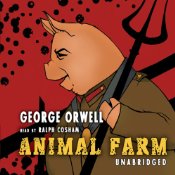
Title: Animal Farm by George Orwell
Publisher’s Summary
George Orwell’s classic satire of the Russian Revolution is an intimate part of our contemporary culture, quoted so often that we tend to forget who wrote the original words. It is an account of the bold struggle that transforms Mr. Jones’ Manor Farm into Animal Farm, a wholly democratic society built on the credo that All Animals Are Created Equal. Out of their cleverness, the pigs Napoleon, Squealer, and Snowball emerge as leaders of the new community in a subtle evolution that bears an insidious familiarity. The climax is the brutal betrayal of the faithful horse Boxer, when totalitarian rule is re-established with the bloodstained postscript to the founding slogan: But Some Animals Are More Equal Than Others.
My Comments:
I will add my comments soon…

by Rupe | Mar 5, 2010 | Not So Recent Reads
Title: World War One: A Short History by Norman Stone
Publisher’s Summary
In 1914, a new kind of war came about, bringing with it a new kind of world. World War One began on horseback, with generals employing bayonet charges to gain ground, and ended with attacks resembling the Nazi blitzkriegs. The scale of devastation was unlike anything the world had seen before: 14 million combatants died, a further 20 million were wounded, and four empires were destroyed. Even the victors’ empires were fatally damaged.
An overwhelming disaster from which the world is still recovering, World War One can seem baffling in its complexity. But now Norman Stone, one of world’s greatest military historians, has composed a dazzlingly lucid and succinct history of the conflict. Stone has distilled a lifetime of teaching, arguing, and thinking into this brisk and opinionated account of the fundamental tragedy of the 20th century.
My Comments:
I will add my comments soon…..

by Rupe | Mar 5, 2010 | Not So Recent Reads
Title: Sample Capitalism: A Very Short Introduction by James Fulcher
Publisher’s Summary
Capitalism deals with the issues that have preoccupied thinkers from Marx and Weber through to Cuddens and Soros. It examines not only issues of great contemporary importance, such as modern globalization and ecological crises, but also looks at examples from the ancient world.
Explaining the origins of capitalism, this Introduction raises the issue of whether capitalism indeed originated in Europe. Next it examines a distinctive stage in the development of capitalism that began in the 1980s in order to understand where we are now and the various stages that have evolved since. Fulcher goes on to explore whether capital has escaped the nation-state by going global (while emphasizing that globalizing processes are not new and questioning whether capitalism is global in character.)
The book discusses the crisis tendencies of capitalism, such as the Southeast Asian banking crisis, the collapse of the Russian economy, and the 1997-98 global financial crisis, and asks whether capitalism is doomed. In the end, the author ruminates on a possible alternative to capitalism, discussing socialism, communal and cooperative experiments, and the alternatives proposed by environmentalists.
My Comments:
I will add my comments soon….

by Rupe | Dec 4, 2009 | Inspiration, Military-Political
Following is the text of President Obama’s address on a new strategy for the war in Afghanistan, as released by the White House on Tuesday 1 Dec 2009; for me this is one of, if not his finest:
Good evening. To the United States Corps of Cadets, to the men and women of our Armed Services, and to my fellow Americans: I want to speak to you tonight about our effort in Afghanistan — the nature of our commitment there, the scope of our interests, and the strategy that my administration will pursue to bring this war to a successful conclusion. It’s an extraordinary honor for me to do so here at West Point — where so many men and women have prepared to stand up for our security, and to represent what is finest about our country.
To address these important issues, it’s important to recall why America and our allies were compelled to fight a war in Afghanistan in the first place. We did not ask for this fight. On September 11, 2001, 19 men hijacked four airplanes and used them to murder nearly 3,000 people. They struck at our military and economic nerve centers. They took the lives of innocent men, women, and children without regard to their faith or race or station. Were it not for the heroic actions of passengers onboard one of those flights, they could have also struck at one of the great symbols of our democracy in Washington, and killed many more. Click to continue…
by Rupe | Dec 4, 2009 | Money Matters
Note: Quick read by Thomas Stanley on low profile millionaires…
 A producer from ABC’s 20/20 news magazine television show once asked if I could identify neighborhoods where the millionaire next door types live. After checking my database, I pinpointed several neighborhoods where these people resided. The resulting televised program certainly raised eyebrows. Most of the homes depicted were in the $200,000 to under $400,000 price range. All of the millionaire next door types who lived in these neighborhoods had an investment portfolio of at least $1 million. Yet the median price they typically pay for a bottle of wine is just over $10.00 – certainly not the acting rich crowd.
Then I did a statistical analysis of my data base and ultimately a profile of millionaires who live in homes currently valued at between $125,000 and $395,000, the low profile millionaires next door. A more detailed examination of the data brought to mind another television episode. It took place while I was promoting The Millionaire Next Door on the Oprah Winfrey Show. A rather well dressed woman from the audience asked me the same question I had heard a thousand times before: What good does it do to have all this money if you don’t spend it? The woman was agitated, even indignant, that I was touting frugality. She further indicated that these people couldn’t possibly be happy. She, like most people who are not wealthy, believed that the more one spends, the more satisfying life is. Thus, more money translates into more spending and therefore more happiness.
(more…)